Scroll down or Click to Jump to: Freezing Baby Food Puree | Storing Baby Food Puree in the Refrigerator | When to put the Puree into the Freezer or Refrigerator
How To Make A Baby Food Purée
1. Start by cooking the vegetable/fruit either by steaming, baking, microwaving or boiling.
Steaming maintains the most nutrients. Steaming, baking and boiling all allow for big batches of foods to be made at one time.
Microwave if you have a small appliance or for when you plan to puree only a
full ice tray of food. Many parents prefer to not use a microwave; we suggest
that you steam or bake as the preferred cooking method! Read all about the various Cooking Methods and Baby Food.
2. Take the vegetable/fruit and remove them into the machine you have
decided to use for pureeing.
3. Set aside the liquid that the vegetable/fruits were cooked in. This will be
the liquid you add to make the puree. (do not use reserved water from carrots
or other high nitrate veggies for a baby under 7 months old! Read more about Nitrates ) You may also thin with Formula, Breast Milk or Plain Water.
Adding this liquid also helps to preserve any nutrients that may have leeched into the water during cooking.
4. Set your machine to puree or grind and begin to mash the vegetable/fruits.
5. As you are pureeing/grinding, add the liquid or plain water. You may use formula or breast milk if you so desire. These liquids give a little nutritional boost and add a familiar taste for baby. Pureeing without adding any liquids is also a good idea. Many parents prefer to thin their foods before they will serve them to their babies. We tend to prefer this as well!
NOTE: For every type of machine you may use to puree, the secret seems to be in how much food you put in the container baskets to begin with. No appliance will do a good job if over stuffed! Fill the containers less than half way full and add a scant amount of liquid to begin with.
Visit our Safe Baby FoodPreparation Methods to learn more about baby food safety.
Visit our Methods for Storing and Freezing Homemade Baby Food to learn more about the various ways to freeze and store homemade baby food.
Should I use a Blender or a Food Processor? Read our article and find out the differences and the secrets!
Visit our Homemade Baby Food Feeding Tools page for Blender, Food Processor and Kit recommendations.
SUGGESTED APPLIANCES TO USE
FOR THE 3 "STAGES" OF BABY FOOD |
| Stage "1" for the thin watery puree's that make baby's first solids
|
Use a Blender, a good Hand/Wand/Stick Mixer, a Vita-Mix or a Food Processor.
Use the "liquefy" and/or "purée" settings.
|
Stage "2" for more thick puree's as baby moves onto more texture
|
A Blender, a good Hand/Wand/Stick Mixer, a Vita-Mix , a Food Mill/Grinder, a "Ricer", a Potato Masher or a Food Processor should take you through this stage as well.
Adjust the settings on your machine to "blend", "mix" and "purée" using more of a pulse than a continual whir.
|
Stage "3" and beyond for chunky, thick puree's and "table foods"
|
A Blender, a Vita-Mix, a Food Mill/Grinder, a "Ricer" , a Potato Masher or a Food Processor should take you through this stage as well.
Adjust the settings on your chosen appliance to "grind", "mix" and/or "chop", again you should use more of a pulse than a continual whir.
|
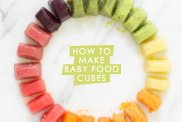
1. Once you have a nice liquid baby food puree you will then transfer the puree into ice
cube trays for freezing/storage.
2. Fill each cube with the puree, as though you were filling the tray with
water to make ice cubes.
3. Cover the tray with plastic wrap (foil may be used however is not
recommended as shards of the foil may be left on/in the food cubes) and put
it in the freezer.
Repeat this process until you have filled all the trays and no puree remains.
(Tupperware and OXO brands (prices from $3.99 to $7.00) make ice cube
trays with lids if you would prefer getting trays with lids)
4. Each cube is equal to approximately 1 ounce of food.
5. Once the cubes of puree have set and are frozen, take the trays out of the
freezer and transfer the cubes into freezer bags.
6. Be sure to label the bag with the date of preparation as well as the type of
food. The baby food cubes should be used within a month of freezing.
7. When it is time to feed baby, simply take out the number of food cubes
needed and thaw and then reheat.
Read our Freezing Baby Food page to learn about what foods will freeze well and other important information.
Back to Top
It is recommended that fresh pureed homemade baby food be stored no
longer than 48 hours (many food safety authorities say that 72 hour is fine!)
in the refrigerator. This limit ensures that bacteria growth in the puree is kept
to a minimum and that the food does not take on the "taste of the fridge"!
This "rule" applies for veggies, fruits, meats etc.
If you do not plan to freeze your homemade baby food, we would suggest
that you make the puree on a day to day, or every other day, basis. For
example, one sweet potato may be baked and then you may freeze one half
without pureeing it and then puree the other half. This method will help cut
down "waste" and also allow for food safety.
Experts say that it takes an infant between 15-21 instances of trying a food
before a true like or dislike is established. If you are just beginning to
introduce solid foods, you really will not be able to determine if your baby has
a true dislike for a food until much later. Freezing purées allows you to go
back and try a "rejected" food over again. Even if you will be strictly following
the 3-4 day wait rule, we still recommend freezing baby food purees for
optimal food safety!
If you do make small batches and store in the refrigerator, please keep in mind that you should not feed your baby from the container and then
re-store. Saliva may contaminate the food and bacteria may evolve. Always
take the portions you will serve from the container and transfer to a feeding
bowl.
back to top
Visit our Freezing Baby Food page to learn about Freezing Methods and the foods that freeze well.
While the professional food jury is still a bit divided, the most highly
recommend food safety advice on storing foods from the majority of food
sources is this:
Refrigerate or freeze perishable foods promptly!!
Harmful bacteria can grow rapidly if foods aren't properly cooled. Refrigerate
or freeze perishable foods within two hours of purchasing or preparing them.
If the room temperature is above 90 F, refrigerate perishable foods within one
hour. Freeze ground meat, poultry, fish and shellfish if you don't expect to eat
it within two days, and freeze other beef, veal, lamb or pork within three to
five days (read the Mayo Clinic Freezing Information page)
Some say that immediately transferring HOT foods to the freezer is NOT good
because that hot food will affect the temperature of the foods around it and
quite possibly the temperature of the whole freezer.
We recommend transferring the food you have cooked to the fridge and then
to package for freezer storage within 2-3 hours. You may safely leave
prepared foods in the fridge for up to 48 hours (72 MAX) so it is up to you
whether you want to immediately move your foods to the freezer.