It's time to think about introducing your baby to solid foods!
We know that this can be a very frightening and daunting stage for many parents. We have compiled solid food charts to help you have an idea of what foods are safe, healthy and nutritious for your baby as you both begin the journey into solid foods
We have also compiled a Sample Schedule for Introducing Baby's First Foods! that you may find useful. This table gives you an idea of how and when to begin introducing baby to solid foods. Please keep in mind that this table was created from our own experience and should be used as a guide only. Always consult your baby's pediatrician about solid foods!

When thinking about starting baby on solid foods and introducing solids to baby, a good rule of thumb is to "Watch the Baby - Not the Calendar!" This is true when introducing solid foods (complementary foods) for both breastfed and formula fed infants. Just because baby has turned 4 months old does not mean she needs to be introduced to solid foods!
Start out slowly, preparing a tablespoon sized portion of whatever food you have chosen to begin with. Some parents begin offering their babies solid foods by using their (clean and washed) finger as a spoon! They say that this helps their babies take to solid foods because the "new" spoon and the "new" food all at once seem to confuse baby!
How much will your 4 month - 6 month old baby eat at his first meal?
You will probably only manage to have baby eat 1/2 of the tablespoon sized portion the very first times you begin solids. Don't fret if your baby does not "finish" a meal. Remember this is a new experience for your baby! As your baby becomes accustomed to eating solids, you will gradually increase the portion sizes. Remember, breast milk and/or infant formula are providing for the total nutrition of your baby at this stage! Read our How Much Food Should My Baby Eat page for more information.
Many parents find their babies will push the food out of their mouths on the first few tries. This is normal however it may also indicate that your baby is not yet ready for solid foods. Only you know your baby and will be able to decide if baby is truly ready for solids.
Read our Solid Food Chart for the 4 - 6 month old baby below:
AGE/STAGE The AAP recommends that an infant not be started on solid foods until after 6 months of age. Many pediatricians still start babies on solids around 4 months of age. This chart accommodates all ages and stages up to 12 months. |
CEREALS Rice and Oatmeal cereals are the least of the allergenic grains and thus most babies are started out with those cereals. |
FRUITS May be served raw after 8 months old – bananas and avocados do NOT need to be cooked ever |
VEGGIES Always serve cooked until after 12 months old or when baby can chew well enough so that no choking hazard is present. |
PROTEIN Always serve cooked with no pink areas – NEVER give a small baby/child raw meat or fish |
DAIRY NEVER replace breast milk or formula until after 12 months of age – serious health risks are possible. Never give a child under the age of 2yrs |
Four to Six (4-6) Months old
Try mixing together the foods that you have already introduced without allergies or reactions. Rice Cereal mixed with Bananas for example.
|
CEREALS
Rice Barley Oat
|
FRUITS
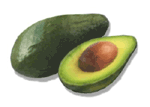
Apples Bananas Pears Avocado
|
VEGGIES
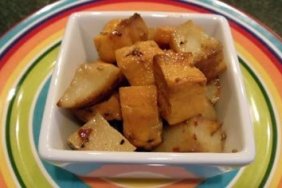
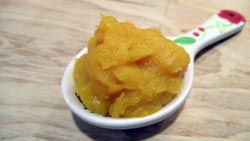
Sweet Potatoes Acorn/Butternut Squash Green Beans
|
PROTEIN
None |
DAIRY
None |
The above chart is a general guideline with solid baby foods that are age appropriate. Our charts/guidelines are somewhat conservative in nature compared to guidelines from other sources. We show age-ranges for different foods and we have researched and compiled these charts from various medical authorities such as private pediatricians, the AAP, the AAFP and the WHO.
Feel free to print the chart and ask your Pediatrician about the listings and recommendations. Our visitors say their pediatricians are impressed with our Chart's suitability and accuracy of listings.
You should always consult your baby’s pediatrician before introducing new foods to your baby. Avoid any suggested foods that may pose an allergy risk for your baby!
Click here for a printable "no ad" version of the complete solid food introduction chart
One Page Condensed Complete Solid Food Chart
Suggested Daily "Milk" Intakes
0-3 Months of age:
Breastfeed every 1-3 hours or Formula 18-40 ounces
4-5 Months of age:
Breastfeed every 2-4 hours or Formula 24-45 ounces
6-8 Months of age:
Breastfeed every 3-4 hours or Formula 24-37 ounces
9-12 Months of age:
Breastfeed every 4-5 hours or Formula 24-31 ounces
Whole Cow Milk, as a drink, should not be introduced until 12 months of age! Learn about Introducing Yogurt and Feeding Cheese to your baby.
compiled from Merck Source
Vita-Mix for Baby! Baby Food Recipes are mixed with ease with the Vita-Mix! Special offer for our visitors FREE Expedited Shipping! Just enter the coupon code ***06-001903-01*** when ordering toll-free at 1- 800-848-2649. Discount automatically applies through online checkout - advertisement
More Baby Solid Food and Baby Food Recipe Topics from our Site
Transitioning to Sippy Cups between ages 6 months to 12 months.
Solid Food Stages & Feeding First Solids Month Range of Feeding Stages & Tips for Feeding First Solid Foods
Introducing Solid Foods by Age Chart for information about what food to avoid and what foods are appropriate for certain ages.
How Much Food Should Your Baby Eat? Not as much as you may be thinking! Read our article and ease your mind!
Is My Baby Ready for Solids? Explore some key signs and points about the readiness for solid foods, weaning and complementary feedings!
Baby's First Foods Homemade Recipes Yummy Homemade Baby Food Recipes for Baby's very first weaning foods!
Baby Menu Sample - We have compiled a sample menu schedule of what a baby might be eating from 4-8 months old and 8-12 months old. Learn how much milk your baby should be drinking through all stages and how many food cubes might be offered for a baby meal.
Off-Site Links to learning more about introducing solid foods
AAP - Breastfeeding for first 6 months of Life
Breastfeeding and the Use of Human Milk -- AAP Policy
American Academy of Family Physicians - Breastfeeding Position Statement
WHO - CAH Exclusive Breastfeeding
WHO - Summary of Guiding Principles for complementary feeding of the breastfed child
JACN - Addition of Solid Foods & Infant Growth
Click here for a printable "no ad" version of the complete solid food introduction chart
One Page Condensed Complete Solid Food Chart

STARTING BABY ON SOLID FOODS
Useful articles and charts to help you with the fun and folly of introducing baby to solid foods!
MORE HOMEMADE BABY FOOD & RECIPE TOPICS
View these pages for more tips & topics.
- Freezing Homemade Baby Foods
- Vitamins & Minerals in Baby's Foods
- Baby Food Myths - Archived
- Baby Food Recipes Downloads
- Freebies for Baby
|
Baby Cubes! Exclusively at OneStepAhead - BPA FREE!
advertisement
New Breast-Fed Baby Growth Charts from the World Health Organisation - Reflecting Breast-Fed Babies Growth Patterns