Homemade Baby Food & Baby Food Recipes

Eggs and Your Baby - Egg Allergies and Baby Food

Infinite Menus, Copyright 2006, OpenCube Inc. All Rights Reserved.
baby food spacebaby spacebaby food space Fresh Fruits and Veggies Homemade Baby Foods - The Best of Nutrition

Allergies & Baby Food - Egg Allergy Information

Google

Web


WholesomeBabyFood

baby food contest


Baby Cubes! at the Baby Center Store
advertisement


Baby Gallery
Is YOUR Baby in our Baby Gallery?


Subscribe to our Newsletter
Email:


FREE stuff for the coming baby!
advertisement 


egg baby food allergy

When can I feed my baby eggs and egg yolks?

Egg Yolks are typically fine for baby to eat around 8 months old.  The egg whites should not be fed to baby before 1 year old. 

Eggs are one of the top 8 of all allergens.  Many studies that have been done on infants with egg allergies find that by the time the infant has reached age 5, the allergy has been outgrown!  This is good news as the egg is highly nutritious and an important part of ones diet!

What is an egg allergy?

As is the process of any allergic reaction, the egg allergy occurs when the body mistakes an egg protein as a harmful invader.  The body reacts by releasing antibodies called immunoglobulin E(IgE).  The IgE in turn prompts the body to release chemicals known as histamines.  When the histamines are released, the body reacts by producing symptoms such as runny nose, itchy eyes, a skin rash and in severe cases, anaphylaxis.

Diagnosing an egg allergy in an infant is really hit or miss and that is why it is very important to follow the 4 Day Wait Rule when introducing your baby to new foods!  If you feel that your baby may have an egg allergy, you may want to begin an Allergy Elimination Diet to determine if the suspect is indeed an egg.

The 4 proteins that are allergens in eggs

A hen's egg white contains 4 proteins that are potential allergens:

      • ovomucoid
      • ovalbumin
      • ovotransfferin and
      • lysozyme

It is the protein ovalbumin, which is the major allergen and it makes up fifty percent of an egg white.

The yolk of a hen's egg also contains proteins however these proteins are seldom allergens.  The proteins are:

      • apovitellenins I
      • apovitellenins VI
      • phosvitin

What are some symptoms of an egg allergy

      • Allergic rhinitis
      • Asthma
      • Dermatitis
      • Diarrhea
      • Gastrointestinal symptoms
      • hives
      • Nausea
      • Oral allergy syndrome (symptoms appear around the mouth, lips and throat)
      • Vomiting
      • Wheezing
      • Anaphylaxis.

If you find that your baby is allergic to eggs, you may want to take note of all the other names for egg products that are used as ingredients in many foods:

EGG FREE DIET

Avoid foods that contain any of the following:

albumin
egg (white, yolk, dried, powdered, solids)
egg substitutes
eggnog
globulin
lysozyme (used in Europe)
mayonnaise
meringue
ovalbumin
ovomucin
ovomucoid
ovovitellin
Simpleese

Note: A shiny glaze or yellow glaze on  baked goods usually indicates the presence of egg.


Should I feed my baby egg yolks?

As mentioned, egg yolk allergy is very rare.  If your family has a history of egg allergies, then it is best to wait until after 12 months old to introduce egg yolks.  There are ways of preparing egg yolks so that the white is not eaten however it is possible that some of the egg white protein may still be on the yolk itself. 

Many pediatricians will say that using a whole egg in a baked good recipe (for the non-allergic baby/child) is fine for the infant who is between 8-9 months old.  If your baby has had any reactions to foods that you are sure of, it is probably best to use a substitute for eggs in the recipes.  As always, you should consult your pediatrician about specific feeding habits for your infant.  There are many infants to whom generalities may not apply!


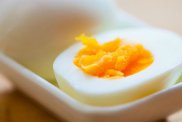
Basic Egg Yolks

1. Hard-boil an egg
2. Peel shell away and cut in half
3. Scrape or pop out the yolk
4. Mash the yolk and mix in formula, breastmilk, yogurt, applesauce or whatever you choose that is appropriate for your baby.

OR

1. Crack an egg and separate the white from the yolk (you may use the shell for this or use an egg-separator)
2. Warm olive oil or butter in a frying pan
3. Scramble the yolk in a bowl with formula, breastmilk, juice or whole milk and transfer to frying pan
4. Cook over medium heat, scrambling constantly, until thoroughly cooked. ** You may also add items such as pureed (or small diced & soft cooked) broccoli, carrots, peas etc...makes great finger food!**

Do Vaccines Contain Egg Proteins?

You should note that many of today's vaccinations are now suspended in egg white protein as a preservative.  Ordinarily, persons who are able to eat eggs or egg products safely can receive these vaccines.   The MMR (measles, mumps and rubella) vaccine does not contain a large amount of the egg white protein and a reaction is unlikely to occur in those with egg allergies.  In fact, many MMR vaccines produced today do not contain any egg protein at all.  The Flu shot and Yellow Fever vaccine however do contain egg protein and those with egg allergies should not receive the Flu shot  or the Yellow Fever vaccine.  Click Here for a list of all vaccines and their ingredients (U.S.) 

Back to Top

Egg Substitutes for both leavening and binding agents:

You may use the following as a leavening agent to replace eggs in any baked good recipe:

bullet

2 tablespoons carbonated water and 2 teaspoons baking flour

bullet

1 teaspoon baking powder, 1 tablespoon water, and 1 tablespoon vinegar (add vinegar separately at the end for rising)

bullet

Dissolve 1 teaspoon yeast in 1/4 cup warm water

bullet

1 heaping tablespoon of soy flour and one tablespoon water

bullet

1 tablespoon bean flour and 1 tablespoon oil

bullet

1 tablespoon of arrowroot powder mixed with 3 tablespoons water

bullet

1 tablespoon cornstarch mixed with 3 tablespoons water

bullet

2 tablespoons gluten flour or unbleached white flour, 1 1/2 teaspoons corn oil, 1/2 teaspoons baking powder, and 2 tablespoons water

You may substitute the following as binders in a baked good recipe

    • 1/2 large mashed banana
    • 1/4 cup apple sauce or pureed prunes
    • 1 tablespoon ground flaxseed mixed with 3 tablespoons water
    • 1 1/2 tablespoons water, 1 1/2 tablespoons oil, and 1 teaspoon baking powder
    • Combine one packet of unflavored gelatin with one cup boiling water - 3 tablespoons of this mixture equal one egg
    • 1 tablespoon apricot puree
    • 1/4 cup of soft tofu
    • 1/4 cup soy milk

Back to Top

Interesting Study regarding Infants and Egg Yolks:

EFFECTS OF INTRODUCING EGG YOLK DURING INFANT WEANING

Weaning* of infants is typically recommended from four to six months of age. It is common today to introduce iron-fortified cereals as first foods, which is in contrast to more traditional weaning practices using egg yolks and grains as first foods. It is important to include iron-rich foods when weaning as breast milk is not a good sole source of iron, and infants generally become depleted by approximately six months of age. Like meat, egg yolks contain both heme and nonheme iron. Heme iron is absorbed more efficiently than is nonheme iron, and its absorption is not significantly influenced by iron status or other constituents of the food. However, absorption of nonheme iron is easily influenced by dietary factors and studies investigating the addition of whole eggs to meals containing nonheme iron show a reduction in iron absorption.

Research has demonstrated that egg white is the culprit as it inhibits nonheme iron absorption. As egg yolks do contain some heme iron and have a soft texture suitable for weaning infants, an investigation of whether egg yolk in the weaning diet can influence iron status is indicated. Additionally, the n-3 long-chain polyunsaturated fatty acid (LCPUFA) docosahexaenoic acid (DHA; 22:6n-3) is an integral component of breast milk, which was not until recently added to infant formula. Previous research demonstrates that infant formula supplemented with DHA, compared with formula containing only precursor fatty acids, improves visual and neural development of preterm infants. To date, no trials have addressed whether weaning foods high in n-3 fatty acids, such as n-3 fatty acid-enriched egg yolks, can improve infant DHA status during late infancy.

The purpose of a recent trial was to investigate the nutritional role of egg yolks in the weaning diets of breast-fed and formula-fed infants. Primary outcome measures included erythrocyte DHA concentrations, infant iron status, and plasma cholesterol concentrations. Secondary outcomes included growth and plasma indexes of allergy. Subjects included healthy six-month-old infants born at term with birth weights of >2500 grams. Infants were eligible for entry into the breast-fed cohort if they received <120 mL formula (or cow milk) per week and were eligible for entry into the formula-fed cohort if they were receiving all their nutrition as formula feeds by four weeks after birth and were subsequently formula fed. Investigators randomly allocated infants to receive either no dietary intervention, regular eggs, or n-3 fatty acid-enriched eggs (n-3 eggs). The goal of the dietary intervention was to include four egg yolks per week in the diet of weaning infants between 6 and 12 months of age without significantly altering intake from other foods. The dietary intervention with n-3 eggs was designed to match the amount of DHA a breast-fed infant would normally receive.

At 6, 9, and 12 months of age, infant weight, length, and head circumference were measured and the infants' mothers completed a brief feeding questionnaire. At 6 and 12 months a blood sample was taken by venipuncture for the assessment of LCPUFA status, iron status, plasma cholesterol, and plasma indexes of allergy.

Erythrocyte DHA concentrations were 30 to 40% higher following the n-3 egg intervention than after treatment with regular eggs or no eggs in both breast-fed and formula-fed infants. Egg treatment had no significant effect on plasma cholesterol, hemoglobin, ferritin, and transferrin but did result in improvements in plasma iron and transferrin saturation compared with no egg treatment. It appears that eggs enriched with n-3 fatty acids may provide a means of increasing dietary DHA during the second six months of life. Egg yolks may also be a good source of iron during the weaning period. Results of this study indicate that egg yolk can be safely included in the weaning diet with no perturbations in plasma cholesterol or increase in prevalence of egg allergies.

M. Makrides, J. Hawkes, M. Neumann, et al. Nutritional effect of including egg yolk in the weaning diet of breast-fed and formula-fed infants: a randomized controlled trial. Am J Clin Nutr 75:1084-1092 (June, 2002). [Correspondence: RA Gibson, Child Nutrition Research Centre, Flinders Medical Centre, Bedford Park, SA 5046, Australia. E-mail: rgibson@flinders.edu.au].

*The term "Weaning" in this study refers to the introduction of solid foods/complimentary feeding of foods. 

Back to Top

A Dozen good reasons to eat eggs:

American Egg Board has proclaimed May as National Egg Month. States across the country will be joining in the celebration of "The incredible edible egg."  To what does the egg owe this honor? There are at least a dozen good reasons.

    1. The news about eggs and heart disease has never looked better. Research continues to show that a small segment of the American population, about one-quarter, may need to monitor dietary cholesterol intake. These individuals typically have high serum (blood) cholesterol, a high triglyceride level and are often diabetic. The remaining three-fourths or so of Americans don’t need to be seriously concerned about dietary cholesterol. They can consume eggs and other cholesterol-containing foods without increasing their serum cholesterol levels. Individuals should consult with their physicians and dietitians and base their dietary decisions on their own individual risk factors for coronary heart disease.
       
    2. Of the mere 5 grams of fat in an egg yolk, only 1.5 grams (31%) are saturated fat. Monounsaturated fats total 1.9 grams (38%) and polyunsaturated0.68 grams (14%). The ratio of an egg’s fat content comes close to meeting the dietary proportions currently recommended-1/3 saturated, 1/3 monounsaturated and 1/3 polyunsaturated. But, before tossing out the yolk, consider that: all of an egg’s vitamin A, D, and E; almost all the vitamin B12, choline, folic acid and vitamin B3; 76% of the biotin, 73% of the inositol, 50% of the niacin, 93% of the vitamin B6, 42% of the riboflavin, 90% of the thiamin substantial portions of the egg’s mineral content and 44% of the protein are in that yolk.
       
    3. One of the most striking features of an egg’s nutrient content is the quality of egg protein. Egg protein quality is so high that scientists often use eggs as a standard for measuring the protein quality of other foods. The Food and Agriculture Organization of the United Nations lists whole eggs as having a biological value of 93.7%. (Biological value is a measurement of protein quality expressing the rate of efficiency with which protein is used for growth.) This rating places eggs above milk (84.5%), fish (76%), beef (74.3%), soybeans (72.8%) and dry beans (58%). Due to their high-quality protein, eggs are classified with meat in the food categories with 1 egg equal to 1 ounce of lean meat, fish or poultry.
       
    4. Varying amounts of 13 vitamins and many minerals are supplied by eggs. Eggs do not contain vitamin C, though this is easily remedied by serving eggs with orange juice, a tomato sauce or broccoli.
       
    5. Foods which supply significant amounts of one or more nutrients compared to the calories they supply are called nutrient dense. Eggs have a high nutrient density because they provide high-quality protein and a wide range of vitamins and minerals in proportion to their calorie count. For all the nutrients it contains, a Large egg has only 75 calories-a relatively low calorie count for a protein food.
       
    6. Americans are eating eggs again. From a 1991 yearly low of 233.5 eggs per person, egg consumption rose to 245 per capita in 1998.
       
    7. While other foods have skyrocketed in price, eggs are still a bargain. When a dozen Large eggs are $1.05 a dozen (average U.S. retail price for 1998), they’re 70¢ a pound. That’s less than 9¢ an egg or a little more than 4¢ for each ounce of high-quality protein.
       
    8. These days, convenience is king and eggs reign. Eggs can be stored in their cartons, in the refrigerator, for about 4 to 5 weeks from the pack date without significant quality loss. In fact, properly handled and stored, eggs rarely "spoil". If you keep them long enough, they’re more likely to simply dry up!
       
    9. Many egg dishes can be prepared with little or no added fat. Poached eggs, scrambled eggs in a non-stick pan, steam based eggs, angel food cake and meringue cookies are but a few examples. To keep egg recipes low in fat, use low-fat dairy products and add vegetables and whole-grain products whenever possible.
       
    10. Speaking of veggies and whole grain foods, nutrition professionals encourage us to include more of these foods in our diets. For many of us, that’s a tall order. But it’s not as hard as it may seem to set your diet right. With their appetite appeal and unassuming flavor, eggs can enhance vegetable and whole-grain foods without overpowering them. In fact, many classic preparations pair the protein of eggs with other foods that contain carbohydrates and fiber.
       
    11. During the week, we all want meals in minutes. That’s where eggs shine. A single-pan scramble, omelet or frittata can be prepared in less than 15 minutes. Depending on the ingredients you choose, these dishes can contain all sections of the Food Guide Pyramid-making them a complete meal. Also, leftovers can be a delicious new meal by using them as a base for eggs. Steam leftover rice, stir in salsa to taste, top with a poached egg and shredded cheese. Or, micro cook leftover vegetables stir in Italian seasoning, top with a fried egg and a spoonful of ready-made pesto, pizza or spaghetti sauce. 
       
    12. Whether you’re concerned about a healthful diet, your food budget or your time schedule, eggs can help balance your meal plans. American Egg Board


BabyCenter Store Earth-Friendly Boutique
advertisement

Wholesome Homemade Baby Food News & Updates


AddThis Social Bookmark Button


Organic Angel Baby Lotion
advertisement


blog
Visit our blog!

Our all-in-one kit, including video, teaches you how to make quick, wholesome meals
advertisement

Fresh Start - So Easy Baby Food Kit


page updated 21 April 2008
 
About Us | Links | Privacy Policy | Home | Contact Us | Back to Top

©Copyright 2003-2008 wholesomebabyfood.com. All Rights Reserved. Information in this website is not meant to be taken as medical advice and thus the information presented should not replace the medical advice of your doctor or pediatrician! Contents of this website may be reproduced only for personal use. Contents may not be reproduced for other use without the express written consent of wholesomebabyfood.com. Privacy Policy & Notices