8 to 10 months Introducing your 8-10 month old baby to solid foods - Finger Food Fun

advertisement 

Solid Foods for Your 8-10 Month old Baby - We're Moving on.


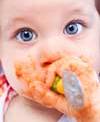
Your 8-10 Month old baby might be crawling and trying to pull herself up. At this stage, your baby may not have a big interest in eating.


As we note in our Is my Baby a Picky Eater page, your baby may suddenly begin to refuse to eat. She's simply too busy to stop exploring her world and she may get quite miffed when you put her in her highchair to eat.


With her independence growing, she may also begin to show preferences for certain foods and Refuse to be Spoon Fed. Take heart - this stage of baby feeding, while quite challenging, will soon pass. Let your baby be your guide and try not to get frustrated. It's important for baby to decide the foods she wants to eat. Before you know it, your baby will be eating all the adult foods and enjoying adult meals.


Bring on some spices (8 months old) and the softly mashed, or chopped into fine pieces of fruits, vegetables, meats, pasta and dairy such as yogurt and cheeses.


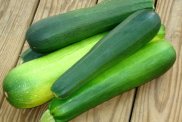
Pasta, veggies, and fruit should all be soft cooked and possibly mashed with a fork or masher. (Bananas need only be mashed.)


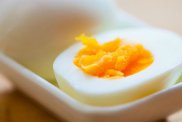
Meats and proteins such as egg yolk, should be cooked and pureed or chopped into small soft bits.  If offering Tofu, you need not cook it first. 


Remember, baby will not have molars until sometime around the 12-18 month age range.  Foods should be easily mashed between the gums.


How much will your 8 month - 10 month old baby eat?


Your 8 to 10 month old baby may seem to be starving herself at some point. Because you are likely offering her more finger food selections or thicker/chunkier foods, the amount of food eaten appears smaller.


At this stage, your baby may be eating 3 "meals" a day and possibly enjoying a snack or 2 in between meals. There are some babies in this age range who will still be eating only 1 "meal" of solids so don't feel pressured to have your baby eat 3 solid food meals per day. The important thing is to watch your baby's hunger cues and let your baby be the guide. Offer him a balanced array of foods - fruits, veggies, a protein & a grain if possible and ensure his nursing or formula feedings are adequate.


Visit our Baby Menu to see an idea of some meals for this age range.


Read our Solid Food Chart for the 8 month old - 10 month old baby below:

tip You should always consult your baby’s pediatrician before introducing new foods to your baby.  Avoid any suggested foods that may pose an allergy risk for your baby.


solid food chart for 8 - 10 months


click to print


The above chart is a general guideline with solid baby foods that are age appropriate.  Our charts/guidelines are somewhat conservative in nature compared to guidelines from other sources.  We show age-ranges for different foods and we have researched and compiled these charts from various medical authorities such as private pediatricians, the AAP, the AAFP and the WHO. Feel free to print the chart and ask your Pediatrician about the listings and recommendations.  Our visitors say their pediatricians are impressed with our Chart's suitability and accuracy of listings. 


AGE/STAGE - 8 months - 10 months old

The AAP recommends that an infant not be started on solid foods until after 6 months of age. Many pediatricians still start babies on solids around 4 months of age.  This chart accommodates all ages and stages up to 12 months.


CEREALS

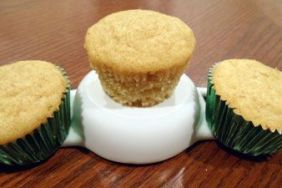
Try mixing together the grains that your baby has had without any reaction(s). Begin offering breads and muffins when baby has mastered mashing more textured foods. Pasta makes for great finger foods.


FRUITS

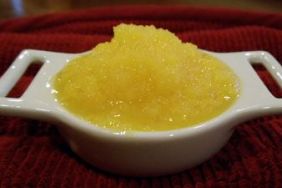
Begin making your own fruit combinations once baby has had several fruits without any reaction(s). Venture into Papaya and Melon Swirl. After 8 months old – you may wish to try offering raw ripe fruits. Soft cooked fruits make for great beginner Baby Finger Foods.


VEGGIES

Soft cooked veggies make for great beginner Baby Finger Foods. Try mixing up a veggie medley now.  Add some grated cheese for extra temptation & Yum. Saute or roast some onions or peppers to add to baby's food or serve as finger foods. Make a Leek and Chicken Potato Mash.


PROTEIN

Once your baby has reached 8 months old, try an Egg Yolk Omelet – the perfect chance to slip in some veggies.


DAIRY

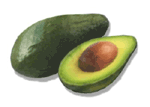
Avocado mashed with a bit of cream cheese – YUM. Get adventurous with Cheeses and Yogurts now. Soft Cheeses such as Brie pose health risks so hold off on those.


Stages of Solid Foods - Baby Let's Eat


(4)6-8 Months - Baby Let's Begin to Eat

"Baby" cereal and soft cooked thinly pureed fruits and veggies should be baby's first solid food experiences. 


Single ingredients only and at a space of 4 days apart with introducing each new food. 


You may skip the cereal and begin with a fruit like avocado or begin with a veggie like butternut squash or sweet potato.


7-10 Months - We're Moving On

Bring on some spices (8 months old) and the softly mashed, or chopped into fine pieces of fruits, vegetables, meats, pasta and dairy such as yogurt and cheeses.


Pasta, veggies, and fruit should all be soft cooked and possibly mashed with a fork or masher. (Bananas need only be mashed.) Meats and proteins such as egg yolk, should be cooked and pureed or chopped into small soft bits.  If offering Tofu, you need not cook it first. 


Remember, baby will not have molars until sometime around the 12-18 month age range.  Foods should be easily mashed between the gums.


Solid Food Charts For Babies:


4-6 Months 6-8 Months 8-10 Months 10-12 Months One Page Complete Solid Food Chart

Suggested Daily "Milk" Intakes

0-3 Months of age:
Breastfeed every 1-3 hours or Formula 18-40 ounces

4-5 Months of age:
Breastfeed every 2-4 hours or Formula 24-45 ounces

6-8 Months of age:
Breastfeed every 3-4 hours or Formula 24-37 ounces

9-12 Months of age:
Breastfeed every 4-5 hours or Formula 24-31 ounces

Whole Cow Milk, as a drink, should not be introduced until 12 months of age. Learn about Introducing Yogurt and Feeding Cheese to your baby.

compiled from Merck Source


Wholesome Homemade Baby Food News & Updates

Introducing Solids and Solid Foods to Your 8 month to 10 month old Baby

8 to 10 months

Solid Food Charts For Babies 8-10 months old

ImageSolid Foods for Baby

Useful articles and charts to help you with the fun and folly of introducing baby to solid foods.


Please be sure to visit our Baby Food Articles Library for more great information about solid foods.

Visit our Baby Food Blog & Check out our Mini Contests.

********
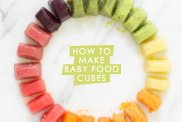
Baby Food Cubes May Be Safely Kept in the Freezer for 3 Months. 

It is preferable, not an absolute must, to use the cubes within 1 month however.


booVisit our Baby's Thanksgiving Baby Food Recipes & Ideas page for yummy Thanksgiving inspired recipes your baby will love.


tip New Breast-Fed Baby Growth Charts from the World Health Organisation - Reflecting Breast-Fed Babies Growth Patterns


Vita-Mix for Baby. Baby Food Recipes are mixed with ease with the Vita-Mix. Special offer for our visitors FREE Expedited Shipping. Just enter the coupon code ***06-001903-01*** when ordering toll-free at 1- 800-848-2649. Discount automatically applies through online checkout - advertisement


wholesomebabyfood recipes links of interest

MORE HOMEMADE BABY FOOD RECIPES & RECIPE TOPICS

View these pages for more tips & topics on baby feeding & cooking baby foods.


icon
advertisement
 
Highlights High Five™

a new magazine for preschoolers.


more baby food links
More Baby Solid Food and Baby Food Recipe Topics -


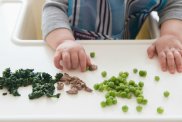
Introducing Finger Foods to Baby


Transitioning to Sippy Cups between ages 6 months to 12 months.  


How Much Food Should Your Baby Eat? Not as much as you may be thinking. Read our article and ease your mind.


© Copyright 2003-2010 wholesomebabyfood.com. All Rights Reserved. Information in this website is not meant to be taken as medical advice, we are not licensed medical physicians, and thus the information presented should not replace the medical advice of your doctor or pediatrician. Contents of this website may be reproduced only for personal use. Contents may not be reproduced for other use without the express written consent of wholesomebabyfood.com. Privacy Policy & Notices